
George Vance Shannon and his business partner bought town acres 403, 404, 405 and 406 in 1878 and proceeded to subdivide them. Shannon Street was formed (along with Moeller and Kennedy Streets) in 1878 when four town acres in Mt Victoria were subdivided.
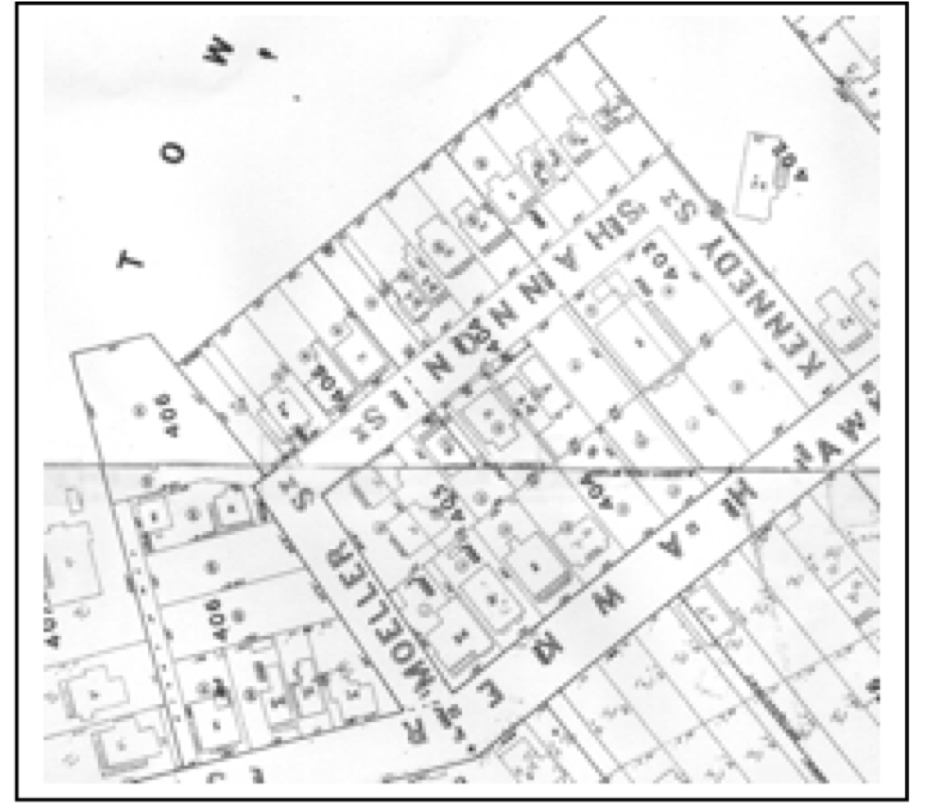
Part of Thomas Ward’s 1891 survey map of Wellington showing town acres 403, 404, 405 and 406. [Wellington City Archives]

George Shannon in his militia uniform. [Cyclopedia of New Zealand, Volume 1, 1897]
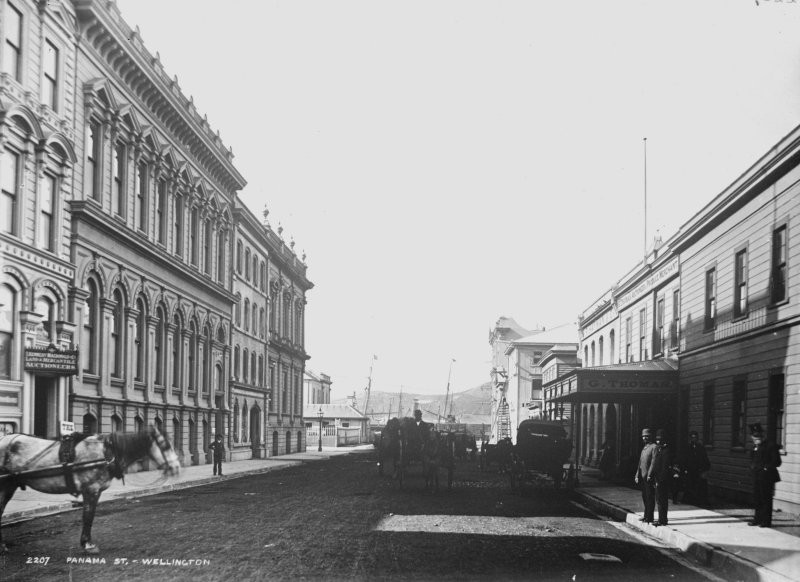
The Thompson, Shannon and Co warehouse in Panama St (the grand building on the left). [Wellington City Archives]
Along with a number of other prominent Wellington businessmen, Shannon was the driving force behind the privately-owned Wellington-Manawatu Railway Company. When the company was formed he, John Plimmer and William H. Levin were the first to agree to take out 2000 five pound shares. He was elected a director and then served as vice-chairman of the Company until he resigned in 1887. In addition to giving his name to the street in Mt Victoria, his name was also given to the town of Shannon on the Wellington-Manawatu railway line.
George and his brothers had strong connections with the Manawatu from 1877, when they bought a 1000-acre block of land there. They also made other land purchases in the area. Although Shannon thought he had retired to a rural lifestyle in 1887 when he left the board of the Wellington-Manawatu Railway Company and moved to his property “The Totaras” in Rangitikei, he was invited by the Premier to be an adviser to Customs in 1888. He accepted and the Premier announced in the House in 1889 that the “customs expert” had saved no less a sum than £5000 during the first seven months of his appointment. Shannon went on to hold the position for 20 years.